The structure and make up of a large market electricity bill can be confusing. But with some basic understanding and having your dedicated energy expert in your corner, how a bill is made up becomes clearer. Which is crucial when making decisions around energy contracts.
The below guide helps unpack with the complexities of a large market power bill.
A large market electricity bill is typically made up of 4 main sections:
Energy Charges
Network Charges
Environmental Charges
Regulated and metering charges
The look and feel can vary depending on your retailer and how big the usage is, but the general make up is the same.
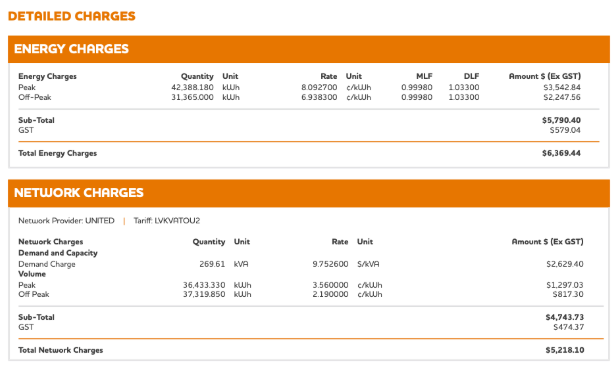
Energy Charges
Is the usage component of your bill. In the simplest form, peak is daytime usage and off peak is nighttime + weekend usage. Some bills will also have shoulder which are also daytime hours. There are some variations here dependent on your state, network and retailer. The exact times will be listed on your contract. Or your dedicated energy broker can assist in providing you with the exact times.
Understanding these can be crucial depending on how your business operates. For example a bakery that is operating early morning before the sun comes up may be more interested in the rates for off peak power.
Network Charges
Network charges are a pass through rate from your network. These charges are for the upkeep on the poles, wires and infrastructure that delivers power through the grid and ultimately to each business.
They typically make up between 40% and 60% of your total electricity bill. You cannot choose your network. Your network is determined by geography and where your business is located. To help explain this, we’ve created a visual guide to the major electricity distribution network areas across the National Electricity Market.
Each network has a range of tariffs. Each business will be allocated to a tariff based on how much power they use and when they use it. Those rates are then multiplied by how much power is used in that monthly billing cycle.
Many large businesses are also charged demand.
Demand is calculating the highest point of electricity usage at a point in time (monthly or yearly). Your network will calculate this to help handle your highest load and helps with strain on the wider electricity grid.
Your broker is an energy expert. They will be able to assess how you use power and if you may qualify for another tariff which may be cheaper. This will also be an ongoing service. Changes in how you use power or to how your network structures their tariffs can bump you up or down into another category which can be more expensive. So it’s important to have an expert providing an ongoing service here. Network tariffs can also change once or twice a year so important an expert is constantly checking to see if a more optimal tariff is available.
Environmental Charges
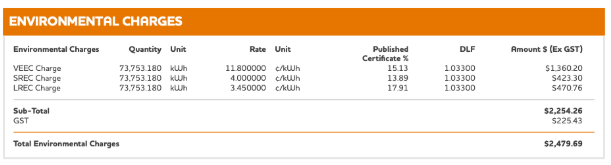
Environmental charges are essentially a government pass through charge. They help fund renewable energy, emissions and other efficiency schemes.
Each bill will typically have a charge for large renewable energy schemes (LREC/LRET), small renewable energy schemes (LREC) and state based schemes (such as VEEC for VIC).
These charges are based on percentage certificate prices and fluctuate Environmentals are partially fixed. Certificate price is fixed, percentage is determined every CAL year based on government decision. That rate is then multiplied by how much power is used for that monthly billing cycle.
Regulated & Metering Charges
AEMO
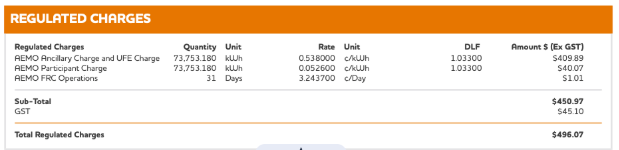
AEMO (Australian Energy Market Operator) is the organisation that essentially runs the National Electricity Market (NEM) which includes all of Australia except WA and NT.
The AEMO charges on your bill are administration charges to help run and oversee the market in the NEM. It is also a set rate multiplied by the usage during that month.
METERING
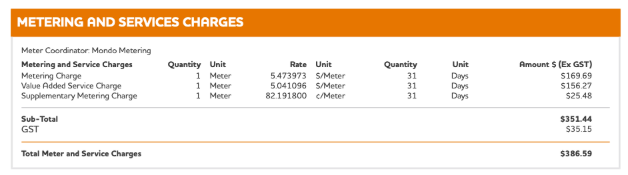
All large market electricity users have a large market meter. It allows for the electricity usage to be settled in 5 minute intervals to closely monitor how and when power is used.
Having access to this meter data is incredibly valuable for a business particularly when they use an energy broker. A broker is able to cross check the actual meter data against what is charged on a retailer's bill. There can be errors which can be very costly. And a good broker will be able to monitor, pick up and fix the errors for the customer.
Large market electricity bills are complex in their make up and for many to understand. The above information can be used as a basic guide. There can be other information and factors that are important to understand and consider. Your Choice Energy energy expert can discuss in further detail to help with your decision making.